StoryCanvas & Beyond StoryCanvas
Visual Comic-Storyboard Authoring & Runtime Analysis for Plan-Based Interactive Drama
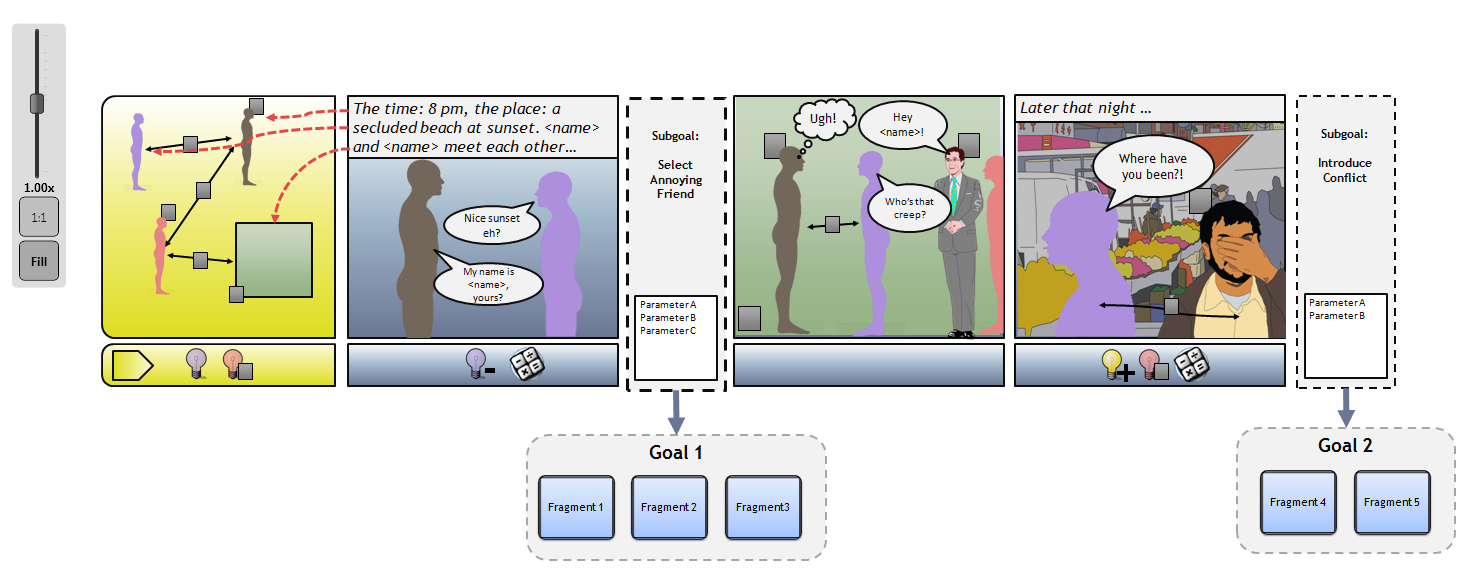
StoryCanvas: Novice-Friendly Authoring of Plan-Based Storyboards
StoryCanvas is a comic- and storyboard-based interactive story authoring and generation environment built on the author-goal-centric UNIVERSE planning model introduced in Wide Ruled.
Creating generative, branching stories is fundamentally akin to programming a reactive state machine—a daunting barrier for writers and narrative designers without formal computer science training. Inspired by the expressive visual shorthand of comic books and film storyboards, StoryCanvas replaces text-heavy rule tables with direct visual manipulation of characters, environments, precondition badges, and comic panels.
To help authors manage large, combinatorial narrative spaces, StoryCanvas pairs visual authoring with continuous real-time feedback on the topology, coverage, and branching factor of the underlying plan-based story world.
Beyond StoryCanvas: Runtime Story-Space Analysis & Mixed-Initiative Planning
As part of my Ph.D. advancement research at UC Santa Cruz, I designed a suite of next-generation architectural extensions (Beyond StoryCanvas) addressing scalability and mixed-initiative AI collaboration in large interactive narratives:
1. Passive Story-Space Exploration & Coverage Heatmaps
Any rich generative story contains a deep hierarchy of Author Goals, Plot Fragments, and interdependent state preconditions. To give authors an immediate mental model of how their rules interact at runtime, a background analyzer continuously simulates playthroughs as the author edits—rendering a reachability heatmap directly over the goal hierarchy to expose dead ends, starving branches, or over-dominant plot fragments (effectively continuous runtime code-coverage analysis for narrative planners).
2. Structural Hierarchy Compression & Procedural Panel Modifiers
- Subtree Collapse & Similarity Compression: Automatic and manual folding of large Author Goal subtrees based on structural and semantic similarity across Plot Fragments.
- Visual Storyboard Pane Modifiers: Precondition-driven actions that dynamically alter panel framing (camera pan/zoom composition) and color grading to reflect shifting character emotions or world state without requiring duplicate art assets.
3. Mixed-Initiative “Delinearization” via Social Physics (Comme il Faut)
To bridge traditional linear storyboarding with branching AI planning, I designed a mixed-initiative workflow powered by the Comme il Faut (CiF) social-physics engine (used in UCSC’s Prom Week by Josh McCoy):
- Step A (Linear Draft): The author sketches a straightforward linear sequence of story panels.
- Step B (Planner Query & Exploration): The author highlights a subsequence of panels and asks the planner to “delinearize” it. Using a corpus of social rules and dramatic arc heuristics (rising tension, conflict, denouement), the planner searches the space of character traits and relationships to suggest candidate branching Plot Fragments.
- Steps C & D (Selection & Branch Integration): The author tunes character traits or accepts one or more AI-suggested variations, which are automatically woven into the Author Goal hierarchy as playable branches.
Screenshots & Figures
Prototype Screenshot: Visual hierarchy of Author Goals and associated Plot Fragments.
Prototype Screenshot: Visual precondition and storyboard action editor.
Prototype Screenshot: Interactive comic-book reading interface with contextual reader goals.
Design Illustration: Visual metaphors for Plot Fragment preconditions and storyboard panel actions.
Design Illustration: Dynamic comic-strip layout and reader agency controls.
Design Illustration: Real-time topology and branch coverage feedback across the story world.
Beyond StoryCanvas: Background Monte Carlo story-space analyzer rendering reachability heatmaps over Plot Fragments.
Beyond StoryCanvas: Structural collapse of Author Goal subtrees for managing large narrative hierarchies.
Beyond StoryCanvas: Similarity-driven visual compression of related Plot Fragments.
Beyond StoryCanvas: Precondition-driven camera pan/zoom composition and mood color shifts on story panels.
Beyond StoryCanvas: Mixed-initiative 'delinearization' assistant using CiF social physics to suggest branching plot fragments (Steps A–D).
Beyond StoryCanvas: Alternating open-ended social simulation gameplay with generated comic storyboards.